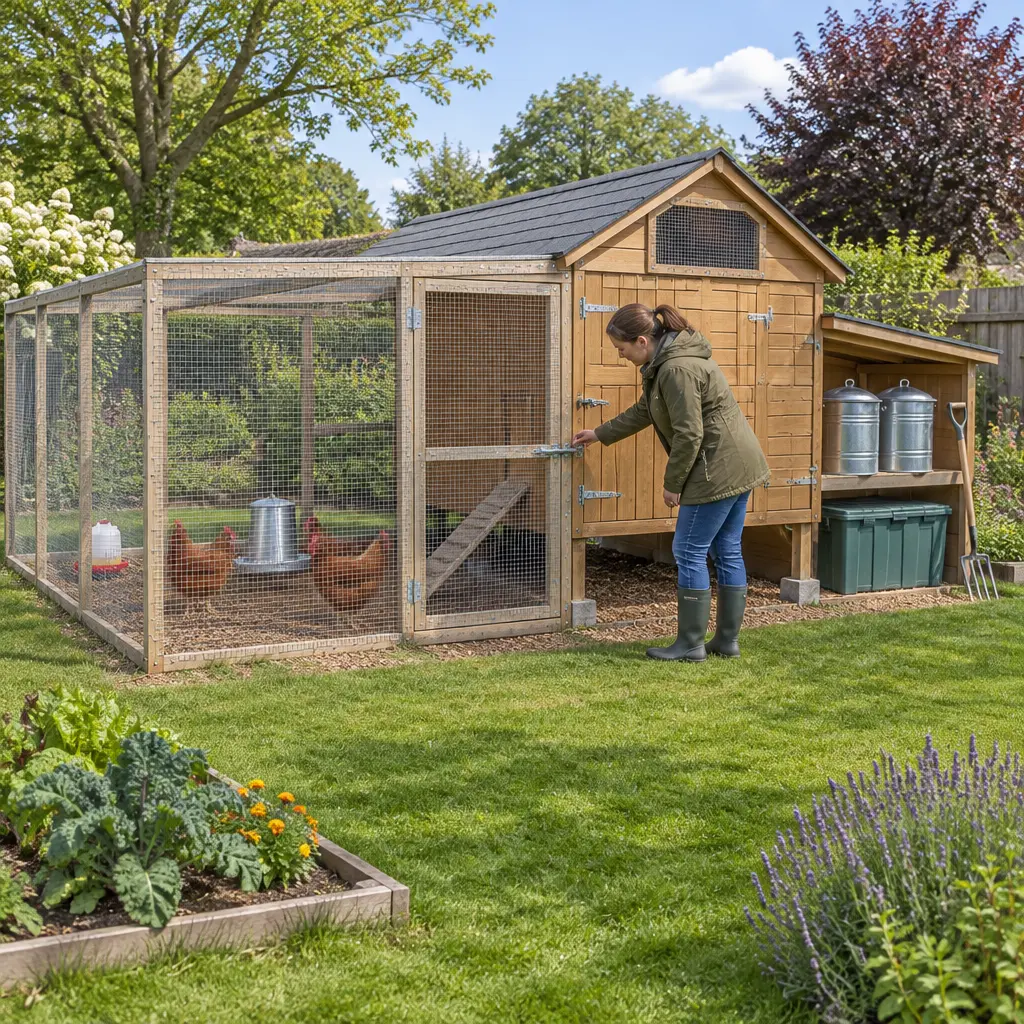
Raccoons can defeat a chicken coop that looks secure because appearance is not the same as resistance to paws, climbing, digging, or persistent prying. The National Wildlife Control Training Program describes raccoons as adaptable animals that can exploit food and access opportunities around buildings; university extension guidance likewise warns that ordinary chicken wire is not a dependable barrier against determined predators. The practical defense is a complete system: sturdy hardware cloth over openings, secure doors and latches, protected edges, and a nightly routine that leaves no easy access to birds or feed.
Raccoon entry tactics explain coop security gaps
A security gap is any opening, weak connection, or routine that lets a predator reach poultry despite the coop’s apparent enclosure. Wildlife biologists generally describe raccoons as opportunistic, dexterous omnivores: their forepaws can manipulate objects, and their climbing ability lets them approach roofs, vents, and elevated openings as well as ground-level edges. A coop therefore has to resist more than a simple straight-ahead push against a wall.
Prying, lifting, and manipulating latches
A latch gap occurs when a door is held by a closure that can be lifted, nudged, or worked loose. A hook, simple sliding bolt, or lightweight turn latch may appear closed but still leave a raccoon room to manipulate it. The University of Minnesota Extension recommends secure housing and dependable closures as part of poultry predator prevention. Use a strong latch that requires a deliberate human action—such as a carabiner or locking clip—and test the door by pulling and pushing from several directions.
Climbing to rooflines, vents, and openings
An elevated-entry gap is an opening reachable by climbing, including roof edges, poorly screened vents, and spaces where roofing meets siding. Raccoons can climb trees, posts, and rough building surfaces, so a tall wall alone does not make a coop safe. Screen ventilation openings with securely fastened, small-aperture hardware cloth rather than relying on a loose screen or a gap beneath an eave. Trim branches that provide convenient access to the roof, while keeping necessary ventilation unobstructed.
Digging and weak perimeter edges
A perimeter gap is a route under a wall, run, or fence. Even when a raccoon is not the only animal capable of digging, exposed soil at the base of a poultry enclosure can invite attempts to get underneath. The University of California Agriculture and Natural Resources recommends predator-resistant construction and attention to vulnerable enclosure boundaries. A buried apron of hardware cloth extending outward from the run, or a properly buried vertical barrier, can make digging more difficult; inspect the soil line for washouts and newly disturbed earth.
Coop materials determine real predator resistance
Predator resistance depends on material, opening size, fastening, and maintenance—not on a product’s name or the impression of sturdiness. Chicken wire is designed primarily to contain chickens, not to stop predators. Hardware cloth, a welded wire mesh, is usually a stronger choice for covering vulnerable openings, but even robust mesh can fail if it is too large, poorly attached, or left with an unprotected edge.
Hardware cloth versus chicken wire
Hardware cloth is rigid welded mesh commonly used to protect vents, windows, and runs; chicken wire is lighter, twisted wire intended mainly to keep poultry contained. Extension recommendations commonly favor small-opening hardware cloth for predator exclusion, with openings around ½ inch often used where small predators are a concern. Choose a durable gauge appropriate to the installation, overlap seams, and fasten the mesh to solid framing with screws and washers or another robust fastening system. Do not assume mesh alone is secure if a raccoon can pull its edge away from the frame.
Fasteners, seams, and door frames
A connection gap forms where two materials meet: mesh to wood, a wall to the floor, or a door to its frame. These transitions are common failure points because builders may focus on the central panel and overlook its perimeter. Use closely spaced, corrosion-resistant fasteners, reinforce corners, and cover seams with overlapping mesh or trim. Check that doors sit flush and that hinges cannot be pulled free from weak or weathered wood.
Roof and floor protection
A complete enclosure protects the top and bottom as well as the sides. A roof or securely screened overhead run limits access from above; a solid floor or protected perimeter reduces opportunities to enter from below. The best arrangement depends on the site, local predators, and whether birds are confined overnight. Inspect roof panels after storms and make sure that vents remain screened without compromising airflow, which is essential for poultry health.
Daily routines close food and access gaps
A well-built coop can still attract wildlife if food, waste, or open doors create an easy reward. Raccoons are opportunistic feeders, so prevention includes both structural barriers and removing attractants. The U.S. Department of Agriculture’s Wildlife Services guidance on reducing conflicts with wildlife emphasizes making food and shelter less accessible; the same principle applies to poultry yards.
Nightly lockup and head counts
Nightly lockup means bringing birds into a secure house and closing every access point before darkness. Make it a consistent checklist: count the flock, shut pop doors, secure human doors and nest-box access, and verify each latch. An automatic coop door can help with routine timing, but it should be tested regularly and should not replace a manual check for obstructions, dead batteries, or a door that has failed to close.
Feed, eggs, and waste management
An attractant gap exists when accessible feed, eggs, spilled grain, or waste rewards animals for visiting the coop. Store feed in tightly closed, wildlife-resistant containers; clean spills promptly; collect eggs frequently; and manage compost and carcasses so they do not draw scavengers. If feed is offered outdoors, remove leftovers before night. These steps do not replace barriers, but they reduce the incentive for repeated visits and investigation.
Lighting and cameras as supporting tools
Motion-activated lights and cameras can help identify when and where an animal approaches, but they are monitoring tools rather than dependable physical barriers. A camera may reveal repeated visits at a loose gate or feeder; the lasting fix is to repair the weakness and remove the reward. Do not rely on scare devices alone, because animals may become accustomed to predictable signals.
A systematic inspection finds hidden weaknesses
A security inspection treats the coop as a connected system and checks every route from the ground to the roof. The University of Minnesota Extension and other land-grant extension services advise poultry keepers to use secure housing and inspect for predator access. A practical inspection is most useful at dusk, when doors should be shut, and after storms or repairs that may have loosened materials.
The hand-and-light test
The hand-and-light test is a simple way to find openings: close the coop, look for daylight through seams, and try to move mesh, doors, and panels by hand. Pay particular attention to corners, rooflines, vent covers, pop doors, and the junction between the run and the ground. Any opening large enough to admit a paw or allow a panel to flex merits reinforcement, even if the opening appears too small for the animal’s body.
Signs of attempted entry
Tracks, disturbed soil, bent mesh, scratched wood, droppings, and moved containers can indicate investigation or attempted access. These clues are not always sufficient to identify a species, so use a camera or consult local wildlife authorities when identification matters. Record the location and repair the route promptly; repeated activity near one opening may indicate that an attractant or structural weakness remains.
A practical risk-priority checklist
Prioritize the fixes that create a continuous barrier and eliminate easy rewards:
- Replace damaged or oversized mesh on vents and openings with securely fastened hardware cloth.
- Install a latch that cannot be lifted or nudged open, and secure it with a clip or lock.
- Close gaps at doors, roof edges, corners, and the base of the run.
- Add a buried barrier or outward apron where digging is possible.
- Bring birds inside nightly and remove accessible feed, eggs, and waste.
- Recheck the enclosure after severe weather, repairs, or evidence of animal activity.
Conclusion: layered security protects poultry
Raccoons exploit coop security gaps through climbing, prying, manipulation, and investigation of weak edges. Predator-resistant materials matter, but their effectiveness depends on strong fasteners, protected seams, secure latches, and a complete roof-to-ground barrier. Nightly lockup and careful food management reduce the rewards that bring wildlife close, while routine inspections uncover damage before it becomes an entry route.
Start by checking every door, vent, seam, and perimeter edge, then repair the weakest point first. For site-specific advice, consult a local university extension office or wildlife agency, especially if you are unsure which predators are active in your area or how to respond lawfully and humanely.
Sources: National Wildlife Control Training Program, Wildlife Control Technology: Raccoons, https://nwco.net/; University of Minnesota Extension, Protecting Small Poultry Flocks from Predators, https://extension.umn.edu/small-scale-poultry/protecting-small-poultry-flocks-predators; University of California Agriculture and Natural Resources, Predator-Proofing Your Chicken Coop, https://ucanr.edu/; U.S. Department of Agriculture, Animal and Plant Health Inspection Service, Wildlife Services, https://www.aphis.usda.gov/aphis/ourfocus/wildlifedamage