A roaming flock of chickens may find seeds, insects, leaves, and other treats outdoors, but those foods rarely provide a dependable winter ration. Chickens are domestic omnivores, not self-sufficient foragers: short days reduce the time available to find food, while cold, snow, frozen ground, and scarce insects can sharply limit what is accessible. Extension guidance therefore treats pasture and yard forage as supplements, not substitutes for a nutritionally complete feed. Whether a flock can cope depends on climate, land, breed, flock size, and how much feed and shelter its keeper provides—and in most winter conditions, survival should not be left to foraging alone.
Winter foraging and a roaming flock’s food supply
“Winter foraging” means the food chickens can locate and eat outdoors during the cold season. It includes plant material, seeds, fallen crops, and invertebrates, but its availability varies greatly from one yard and week to another. The University of Minnesota Extension advises that chickens need a balanced ration formulated for their age and production stage; pasture and kitchen or garden scraps do not reliably supply all necessary nutrients.
That distinction matters because a bird may appear busy scratching without obtaining enough energy, protein, or minerals. A sparse winter range can still offer useful enrichment, but the flock’s daily nutrition should be measured by dependable feed intake, not by how long birds spend outside.
What roaming chickens may find
Forage is food gathered from the environment rather than supplied in a feeder. Depending on the site, chickens may find grass blades, dormant plant material, weed seeds, spilled grain, berries, and insects or larvae under leaves and debris. These foods can add variety and encourage natural scratching, but their nutrient content and quantity are inconsistent. Once vegetation is dormant or covered by snow, much of that potential disappears.
Why winter changes the equation
Cold weather increases the importance of adequate energy intake, while snow, ice, frozen soil, and shorter daylight restrict access to food. The U.S. Department of Agriculture’s National Agricultural Statistics Service reports that U.S. egg production is a large-scale food system, but commercial production figures do not translate into a backyard flock’s ability to feed itself. For a small flock, the relevant measures are the number and condition of birds, feed consumed, water access, and the amount of usable forage on the property.
A useful visual aid would be a simple seasonal chart showing daylight, ground cover, and forage access month by month for the flock’s local climate. Such a chart should be based on observation of the actual site rather than a generic national estimate.
Winter nutrition and a roaming flock’s survival needs
Winter nutrition is the provision of sufficient energy, protein, vitamins, minerals, and water to maintain body condition and normal functions during cold weather. The Merck Veterinary Manual describes poultry nutrition as dependent on a properly balanced diet, with requirements varying by age and purpose. A complete commercial ration is designed to provide those nutrients in dependable proportions; forage alone is not.
The main categories of winter risk are nutritional shortfall, inadequate water, exposure, and reduced access to food. They interact: a bird that cannot drink normally may eat less, and a bird spending energy to stay warm has less margin for an unreliable diet.
Complete feed versus forage
Complete layer feed is formulated for laying hens, while grower or maintenance rations suit other stages and purposes. Feed labels should match the flock, and a veterinarian or poultry extension service can help resolve questions about mixed-age groups. Scratch grains, scraps, and forage are not balanced substitutes. The University of Minnesota Extension specifically cautions poultry keepers to provide appropriate feed and clean water rather than relying on outdoor access to meet nutritional needs.
A practical check is to monitor feed disappearance, body condition, egg production where relevant, and changes in behavior. A sudden decline in intake or condition warrants attention; it should not be interpreted as proof that birds are finding enough outdoors.
Water and cold-weather access
Water is essential for digestion, temperature regulation, and egg production. In freezing conditions, drinkers can ice over, so poultry keepers should check them frequently and ensure that clean, unfrozen water remains available. Outdoor forage does not compensate for frozen drinking water. Keeping water equipment clean and preventing spills that create icy areas also helps reduce avoidable hazards around the coop.
Shelter, wind, and cold tolerance
Cold tolerance is not the same as winter self-sufficiency. Many healthy, acclimated chickens can tolerate cool conditions when they have dry shelter, protection from wind and precipitation, and adequate feed and water. Dampness and drafts at roost level are more concerning than a low temperature alone. The University of Maine Cooperative Extension recommends a dry, ventilated coop: ventilation removes moisture and stale air, while the birds’ roosting area should not be exposed to direct drafts.
Breed, age, health, comb size, and acclimation affect risk. A roaming flock still needs a secure place to shelter and roost; access to a yard is not a substitute for winter housing.
Winter range and a roaming flock’s local carrying capacity
Carrying capacity is the amount of food and habitat a site can provide without being depleted. There is no single reliable winter carrying-capacity figure for all chicken yards: forage changes with soil, vegetation, weather, flock density, and management. A large, relatively mild property with uncovered vegetation may offer more than a small, snowbound run, but neither should be assumed to replace a formulated ration.
The closely related categories are seasonal forage, managed pasture, and supplemental feeding. Their value is best judged by what birds can actually reach and eat, not by the total area of land alone.
Seasonal forage and snow cover
Seasonal forage is the edible plant and animal material available at a particular time of year. In winter, dormant growth and snow cover can make food inaccessible even when seeds or insects remain beneath the surface. During a thaw, birds may find more; after a storm or freeze, the same ground may yield almost nothing. This variability makes outdoor food an unreliable foundation for daily nutrition.
Managed range and flock pressure
Managed range means directing birds across outdoor areas to reduce concentrated scratching and allow vegetation time to recover. It can improve access to diverse foods in suitable seasons, but winter growth is limited in many regions. If birds repeatedly strip one small area, soil and plant cover can deteriorate, and the range may offer less food over time. Rotating access and observing the ground can help protect the site, but these practices do not eliminate the need for complete feed.
A practical example: the snowbound backyard flock
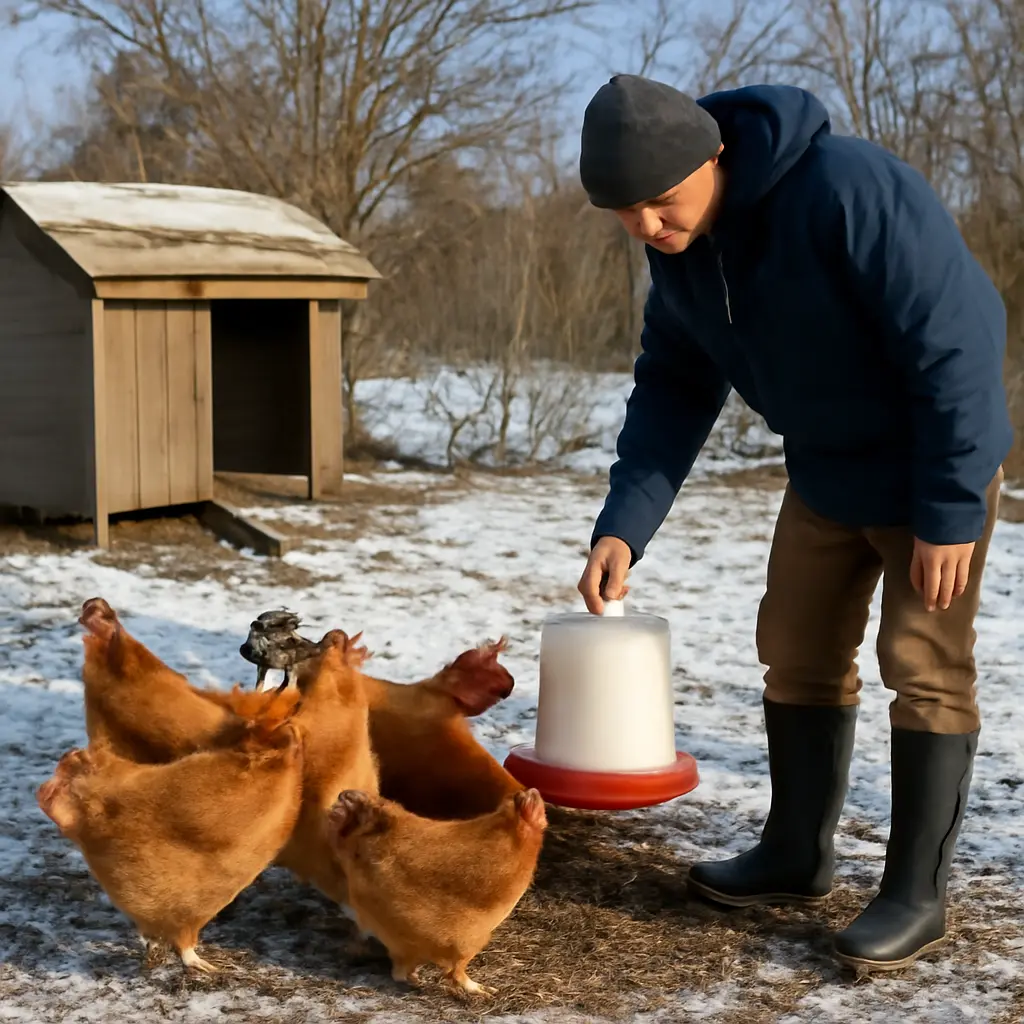
Consider a small flock whose yard is covered by snow for several days. The birds may still scratch near a cleared path or under shrubs, but most seeds and invertebrates are inaccessible. A keeper who supplies the appropriate complete ration, checks water repeatedly, and provides a dry, sheltered coop is managing the actual winter risks. A keeper who assumes that roaming alone will sustain the flock is relying on food that may vanish overnight.
Winter management and a roaming flock’s safety
Winter management combines reliable feeding with safe access to outdoor space. Free-ranging can provide exercise and behavioral enrichment when conditions permit, but a flock should be able to retreat to shelter and should not be forced to forage through hazardous weather. Local extension guidance and a poultry veterinarian are useful sources for advice tailored to regional climate and flock type.
A keeper’s winter checklist
- Provide a complete ration appropriate to the birds’ age and production stage; do not count scraps or scratch grain as a replacement.
- Check daily that feed is dry and accessible and that drinking water has not frozen.
- Keep the coop dry, ventilated, secure, and protected from direct wind at roost level.
- Observe body condition, appetite, activity, and laying patterns, and seek expert advice if birds deteriorate.
- Offer outdoor access only when the range is safe and usable, with shelter available nearby.
- Assess forage on the ground throughout the season; do not assume that a large yard means food is available under snow or ice.
Conclusion: Can a roaming flock survive winter on what it finds?
Usually, a domestic flock should not be expected to survive winter on outdoor forage alone. Winter foraging is variable, carrying capacity falls when plants go dormant or ground is covered, and roaming does not meet the need for balanced nutrition, clean water, and dry shelter. Complete feed, frequent water checks, suitable housing, and careful monitoring make outdoor access a supplement rather than a gamble.
For practical next steps, review your feed label, observe how much usable forage remains on your property, and consult a local poultry extension service for climate-specific advice. The broader lesson is simple: a resilient flock depends not on how much it can roam, but on whether its keeper can reliably meet its needs when nature offers less.
Sources: University of Minnesota Extension, Raising chickens for eggs, https://extension.umn.edu/small-scale-poultry/raising-chickens-eggs; Merck Veterinary Manual, Nutritional Requirements of Poultry, https://www.merckvetmanual.com/management-and-nutrition/nutrition-poultry/nutritional-requirements-of-poultry; University of Maine Cooperative Extension, What do I need to know about caring for my chickens in the winter?, https://extension.umaine.edu/publications/2212e/; U.S. Department of Agriculture, National Agricultural Statistics Service, Chickens and Eggs, https://www.nass.usda.gov/Publications/Todays_Reports/reports/chck0325.pdf.